Grocery prices keep going up, and honestly, most of us don’t even notice we’re overpaying just because we’re looking at the wrong numbers. That jar with the lower price tag?
It might actually cost more per ounce than the big one next to it. If you don’t know the real cost per unit, you’re making budget choices with half the info.
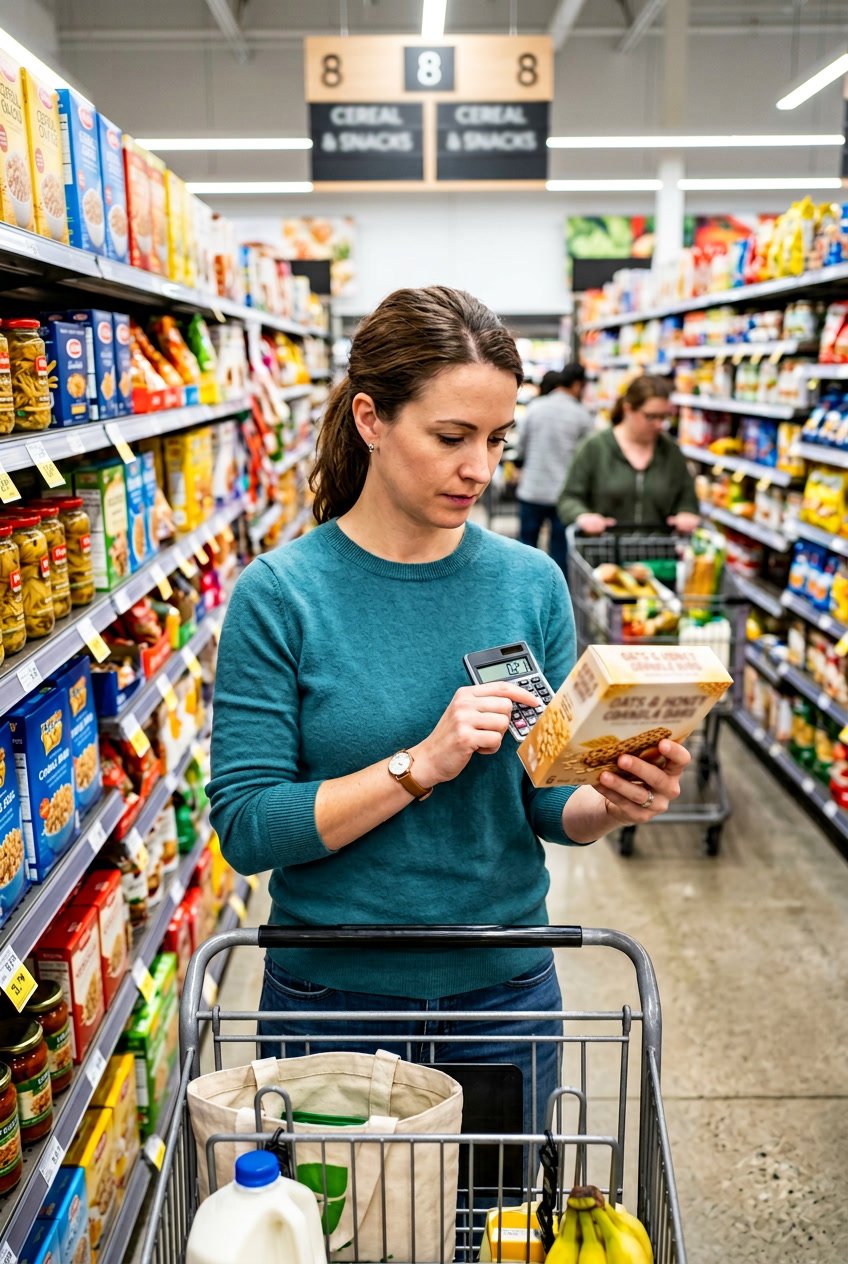
A unit price calculator tells you the real cost per ounce, pound, or item, so you can compare different sizes and spot the actual best deal. This guide will show you how to figure out unit prices for yourself, especially when store labels are confusing or missing, and how this trick can help you slash your grocery bill—no coupon clipping or cross-town trips required.
Key Takeaways
- Unit price shows you the true cost per ounce or pound, so you can compare package sizes the right way
- You can calculate unit price in seconds, which helps if store labels are missing or not helpful
- Checking unit prices regularly can cut your grocery spending without changing your shopping list
What Is a Unit Price Calculator for Grocery Shopping?

A unit price calculator for grocery shopping lets you divide the total price by the product’s quantity, so you see the cost per ounce, pound, or whatever unit you want. That way, you can compare different brands and sizes—even when the packages are totally different.
How Unit Price Differs from Total Price
The total price is just what you pay at checkout, but it doesn’t really tell you if you’re getting a good deal. For example, a 32-ounce jar of peanut butter at $6.40 looks cheaper upfront than a 64-ounce jar at $10.24. But if you check the unit price, you actually see $0.20 per ounce for the small jar, $0.16 per ounce for the big one. The big jar saves you $2.56.
Total price can trick you into thinking smaller packages are a better deal because you spend less in the moment. Unit price cuts through all that packaging nonsense and shows the real cost.
Stores usually print unit prices on shelf tags, but sometimes they’re tiny or just plain missing. Different brands might use ounces, others pounds, which makes it hard to compare without doing a little math. A unit price calculator sorts out all the conversions, so you can pit a 16-ounce can at $2.44 against bulk items at $2.99 per pound, no sweat.
Common Grocery Shopping Scenarios

You’ll reach for a unit price calculator most when you’re comparing store brands to national brands, regular sizes to family packs, or bulk deals. For example, a six-pack of yogurt at $4.49 vs. a 32-ounce tub at $3.99—plug it in, and you’ll see you’re paying $0.75 per cup or $0.12 per ounce.
Multi-item packs can get tricky. Take a 12-pack of 12-ounce soda cans at $5.99 and a 2-liter bottle at $1.89. At first glance, the cans seem like a good deal, but the cans cost $0.042 per ounce, and the bottle only $0.028 per ounce. You save $0.95 per liter with the bottle.
Fresh produce is another spot where it helps. Loose bell peppers at $1.99 per pound versus a three-pack bag (1.5 pounds) for $3.49? The bagged peppers are $2.33 per pound, so the loose ones are actually the better buy, even if you have to pick them out yourself.
Don’t forget about unit mismatches—fluid ounces vs. liters, ounces vs. pounds. A unit price calculator does the conversions, so you don’t have to stand there fumbling with your phone, trying to remember how many ounces are in a liter.
How to Calculate Unit Price: Step-by-Step Guide
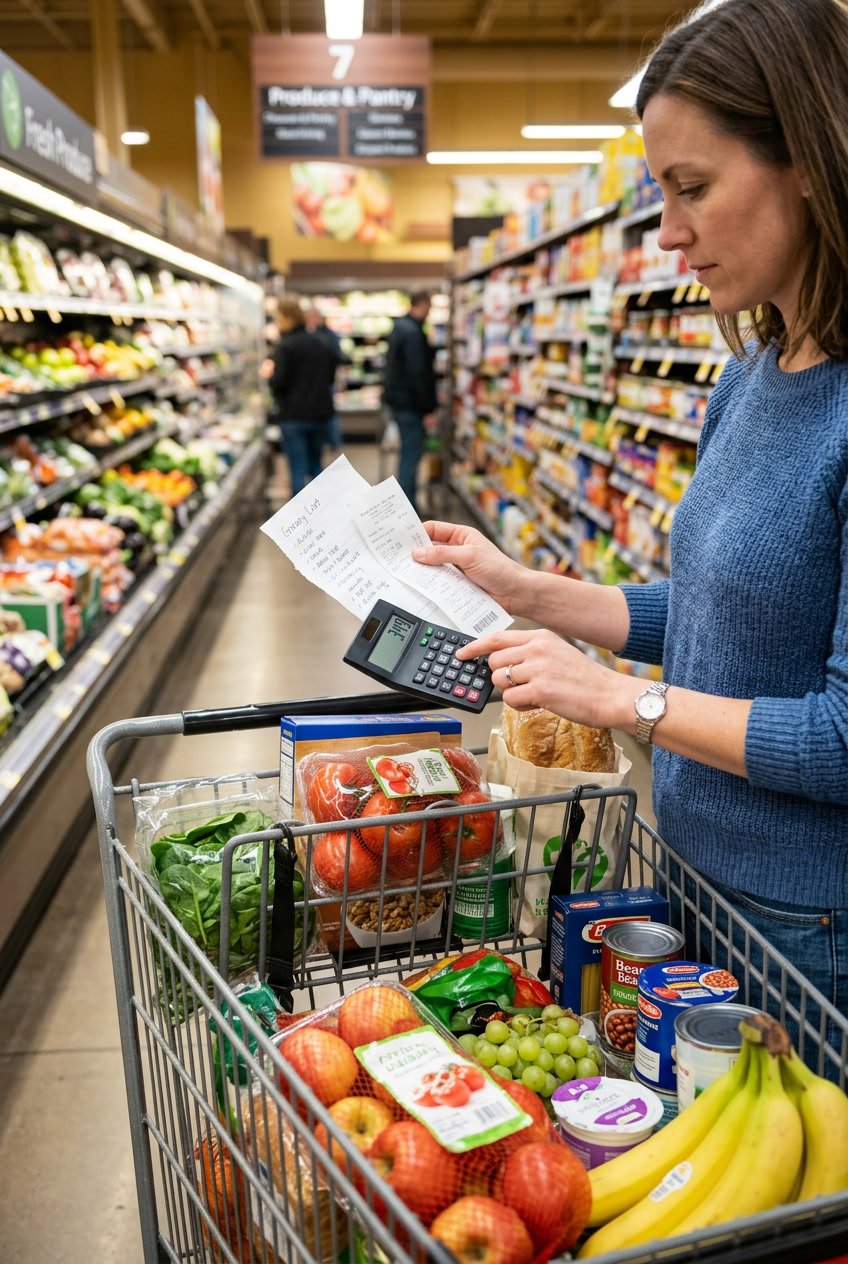
Just divide the total price by the quantity, and you get the unit price. This works for anything—ounces, pounds, count, whatever.
The Unit Price Formula Explained

Here’s the quick math: total price divided by number of units. If your 24-ounce bottle of shampoo is $7.20, you do $7.20 ÷ 24, which is $0.30 per ounce.
Unit Price = Total Price ÷ Quantity
You can use this formula for cereal, meat, cleaning stuff—anything. Just make sure you’re comparing the same units for both products. If you’ve got a 16-ounce jar at $4.00, that’s $0.25 per ounce. The 32-ounce jar at $7.68 is $0.24 per ounce. The bigger one saves you a penny per ounce, which adds up to $0.16 total.
Most stores stick the unit price on the shelf tag, but the units might not match between brands. That’s why knowing how to do the math yourself is handy.
Calculating Cost Per Ounce, Pound, or Item

Check what unit your product uses before you start. Liquids usually use fluid ounces or liters. Solid foods use ounces or pounds. Stuff like paper towels or trash bags? They’re by count.
Here’s how it looks:
| Product Type | Measurement Unit | Example Calculation |
|---|---|---|
| Olive oil | Fluid ounces | $12.99 ÷ 33.8 oz = $0.38/oz |
| Ground beef | Pounds | $15.96 ÷ 3 lbs = $5.32/lb |
| Eggs | Count | $4.29 ÷ 18 eggs = $0.24/egg |
| Laundry pods | Count | $18.99 ÷ 72 pods = $0.26/pod |
Price per pound is super useful for meat, produce, and bulk stuff. Cost per ounce works for packaged foods, drinks, and toiletries. For things sold by the piece, like diapers or batteries, just divide the price by how many you get.
Inputting Prices and Quantities

Jot down or remember both numbers before you start. The price is on the main tag, and the quantity’s usually on the front—look for “NET WT 16 OZ” or “128 FL OZ.”
Your phone calculator is all you need. If you’re comparing a 64-ounce yogurt at $5.49 to a 32-ounce one at $3.29, do $5.49 ÷ 64 = $0.086 per ounce, and $3.29 ÷ 32 = $0.103 per ounce. The bigger one saves you about 1.7 cents per ounce.
Watch out for mismatched units. If one pasta sauce is in ounces and another in grams, convert one. One ounce is about 28.35 grams, so a 24-ounce jar is roughly 680 grams.
Understanding Price Per Unit

Price per unit tells you what you’re really paying for each piece or portion. A $9.99 pack of six paper towel rolls is $1.67 a roll. An $11.99 pack of eight rolls is $1.50 a roll. That’s $0.17 less per roll, or $1.36 saved on eight rolls.
This really matters when prices are close but sizes are different. Two dish soaps might both be around $4, but if one is 16 ounces and the other is 24, you’re getting half again as much soap for the same price.
Don’t assume bigger always means cheaper. Sometimes smaller packages go on sale and beat the “value size.” A 12-ounce coffee bag at $6.99 (58 cents/oz) can be cheaper than a 32-ounce bag at $19.99 (62 cents/oz). The unit price tells you where the real deal is.
Comparing Products and Prices for the Best Value
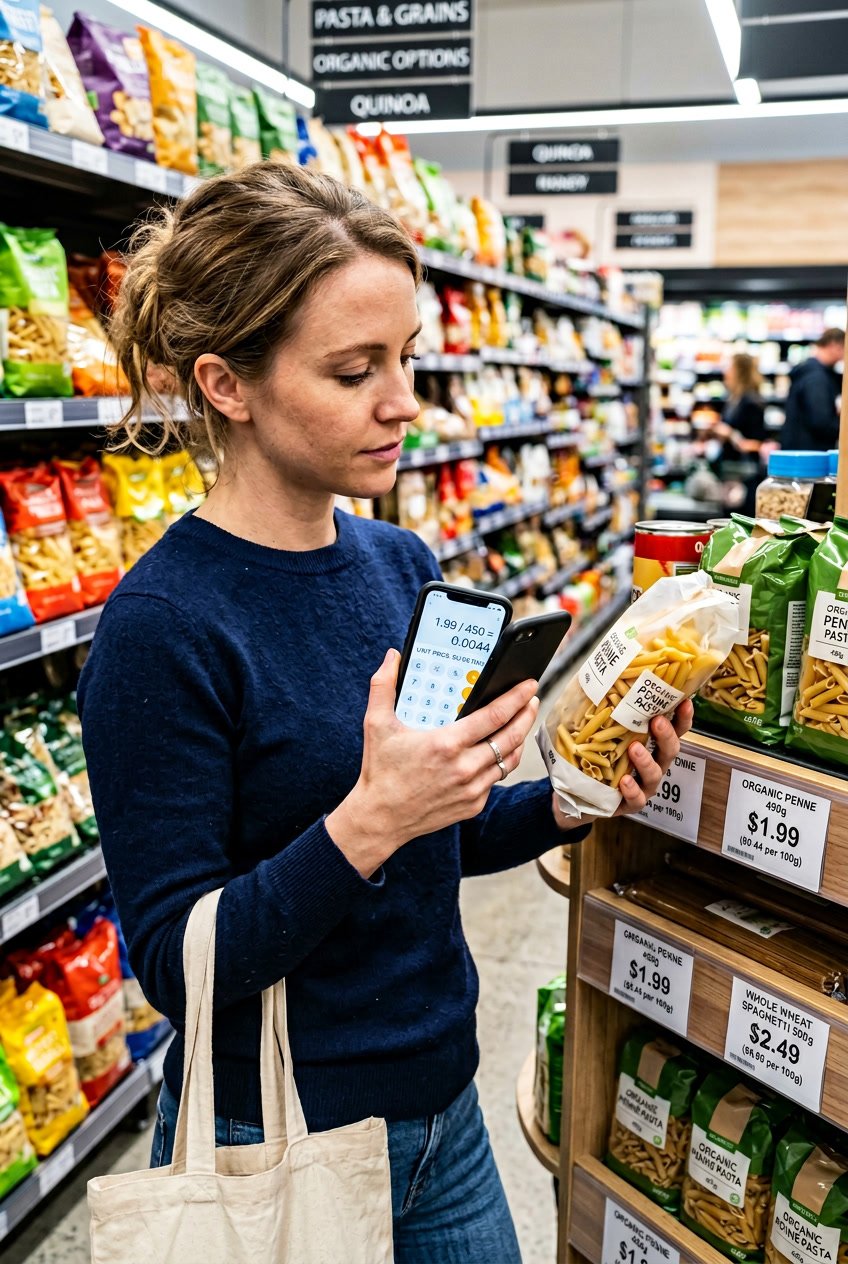
You can shave $30 to $50 a month off your grocery bill by checking unit prices instead of just the sticker price. Different sizes, brands, and stores all price things differently per ounce or pound, and those little differences add up.
How to Compare Items with Different Units

The hardest part? When one product uses ounces and another uses pounds, or you’re comparing a 750ml bottle to a gallon. You’ve got to convert them to the same unit.
Convert pounds to ounces (multiply by 16), kilograms to grams (by 1000). For liquids, remember: a gallon is 128 fluid ounces, a liter is about 33.8 fluid ounces. Stores usually show unit prices, but sometimes they’re off or use different units for different brands.
Here’s a real-world example: Store brand pasta is $1.29 for 16 ounces; name brand is $2.49 for 24 ounces. Store brand is $0.08 per ounce, name brand is $0.10 per ounce. That’s $0.02 less per ounce with the store brand, or $0.32 saved on a pound.
Keep an eye out for sneaky sizing. “Family size” cereal at 19 ounces for $4.99 is $0.26 per ounce. Two regular 12-ounce boxes at $2.99 each are 24 ounces for $5.98—$0.25 per ounce. The smaller boxes actually win, despite the “value” label on the big one.
Using a Unit Price Calculator for Multiple Products

When you’re comparing more than two things, a calculator saves you from mental gymnastics and helps you make faster choices. Just punch in the price and quantity for each, and you’ll see the unit cost side by side.
This is super helpful when you have three or more options. Say you’re buying olive oil: a 17-ounce bottle at $7.99, a 25.5-ounce at $10.99, and a 51-ounce at $18.99. The calculator spits out $0.47, $0.43, and $0.37 per ounce. The biggest bottle saves you $0.10 per ounce compared to the smallest—$5.10 saved if you use the whole bottle.
Most grocery apps and browser extensions have built-in calculators now. Or just use your phone’s calculator: divide price by units. Keep a notes app handy to track your numbers as you shop.
The real magic happens when you compare across stores. A unit price calculator lets you log prices from a few grocery stores, a discount chain, and maybe an online shop, so you can see where the real savings are. Maybe Store A has the best produce, but Store B wins for canned goods and dairy.
Spotting the Best Value in Bulk and Warehouse Clubs

Warehouse clubs like Costco and Sam’s Club love to push the idea that buying bigger always means paying less per unit. Sure, that’s true most of the time—maybe 60-70%—but not always.
Always check the warehouse club unit price against your regular grocery store’s sale prices. Take oats, for example: a 35-ounce container at the warehouse club costs $8.99, so $0.26 per ounce. But your local store might run sales at $3.99 for 18 ounces, which is just $0.22 per ounce. In that case, the warehouse club loses.
Don’t forget the membership fee. If you shell out $60 a year for access, you’ll need to save at least $5 a month on unit prices just to break even. Keep track of your actual savings for a couple of months before you decide to renew your membership.
Items usually worth buying at warehouse clubs:
- Laundry detergent (often $0.10-$0.15 per load vs $0.20-$0.25 at grocery stores)
- Trash bags (unit prices beat grocery stores by 30-40%)
- Batteries (alkaline batteries run about $0.30-$0.40 each vs $0.60-$0.80 retail)
- Paper towels (watch price per sheet, not just per roll)
Items that often aren’t great deals in bulk:
- Spices you won’t finish before they expire
- Fresh produce if you’re only cooking for one or two people
- Trendy snacks that look like bargains but cost more per ounce than store brands
Ask yourself if you’ll really use the bulk amount before it spoils. For instance, a 10-pound bag of flour at $0.25 per pound beats the 5-pound bag at $0.35 per pound, but only if you bake enough to finish it in six months. Otherwise, you’re tossing money when half goes bad.
Budget Planning and Grocery Shopping Strategies
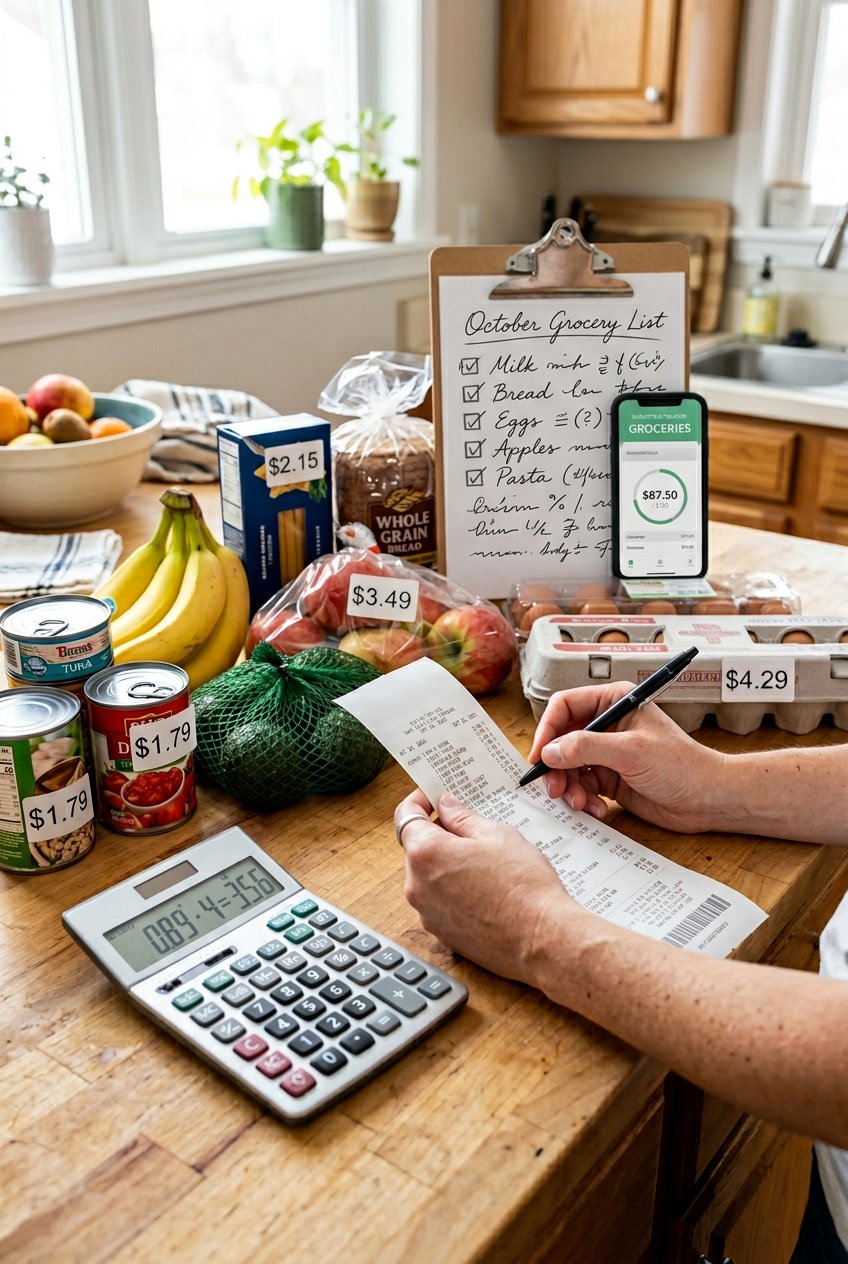
When you use unit price calculations to build your grocery budget, you get a lot more control over your food spending. It also helps you spot real savings and sidestep those impulse buys that sneak into your cart.
Building a Grocery Budget with Unit Price Calculations
First, track what you actually spend for two weeks. Don’t just guess—write down every grocery purchase and figure out the unit price for your regular buys. Patterns will jump out and show you where your cash is going.
Set your monthly grocery budget based on your household size and what you eat. The USDA says a family of four on a moderate plan spends around $1,100 a month, but your number might be higher or lower depending on your location and habits.
Break your total budget into categories:
- Proteins: 25-30%
- Produce: 20-25%
- Dairy and eggs: 10-15%
- Grains and carbs: 15-20%
- Pantry staples: 10-15%
- Household items: 5-10%
Compare unit prices in each category to stay under your limits. Chicken breast at $5.99 per pound vs. thighs at $2.49 per pound? That’s a $3.50 per pound difference. Buy four pounds of thighs and you’ve saved $14—enough to grab extra veggies.
Track your spending each week instead of waiting until the end of the month. This way, you can adjust before you blow your budget.
How to Find the Best Deals Without Extra Effort

Start with unit prices before looking at sales. A “50% off” sticker means nothing if the unit price is still higher than the store brand right next to it.
Download your grocery store’s app and check the weekly ad while making your list. Circle sale items that match what you already plan to buy. Don’t let flashy deals tempt you into buying stuff you don’t need—unless it’s shelf-stable and you’ll definitely use it.
Try these strategies:
- Buy store brands for pantry staples like flour, sugar, canned goods, and pasta
- Compare unit prices between regular and family-size packages
- Look at the lowest and highest shelves for hidden bargains
- Use your phone’s calculator to double-check unit prices
Stock up when non-perishables hit rock-bottom prices. If canned tomatoes drop to $0.79 from $1.29, buy six if you use them often. That’s $3 saved right away.
Shop alone if you can. Bringing kids or a hungry spouse can easily add $20-40 in unplanned extras. One focused trip usually beats several rushed ones loaded with convenience items.
Avoiding Common Pitfalls: Overspending and Waste

Bulk sizes can backfire when food goes bad before you use it. That $12 container of spinach might look like a steal at $0.40 per ounce, but if half spoils, you really paid $0.80 per ounce for what you ate.
Figure out your household’s consumption rate before buying in bulk. If you use one jar of peanut butter every six weeks, buying four jars just because it’s cheaper per unit ties up $15 that could cover this week’s groceries.
Watch out for these costly mistakes:
- Shopping hungry (your cart will grow by 15-20%)
- Buying perishables without a meal plan
- Ignoring expiration dates on sale items
- Assuming bigger always equals cheaper
- Forgetting about storage space at home
Stores sometimes trick you with “unit price deception”—one item is per ounce, another per pound. Convert everything to the same unit before comparing. Your phone’s calculator can save you $2-3 each trip.
Set a hard budget for every trip and track your total as you shop. When you hit your limit, stop. This forces you to prioritize and avoids that nasty checkout surprise.
Tools and Tips for Saving at the Grocery Store
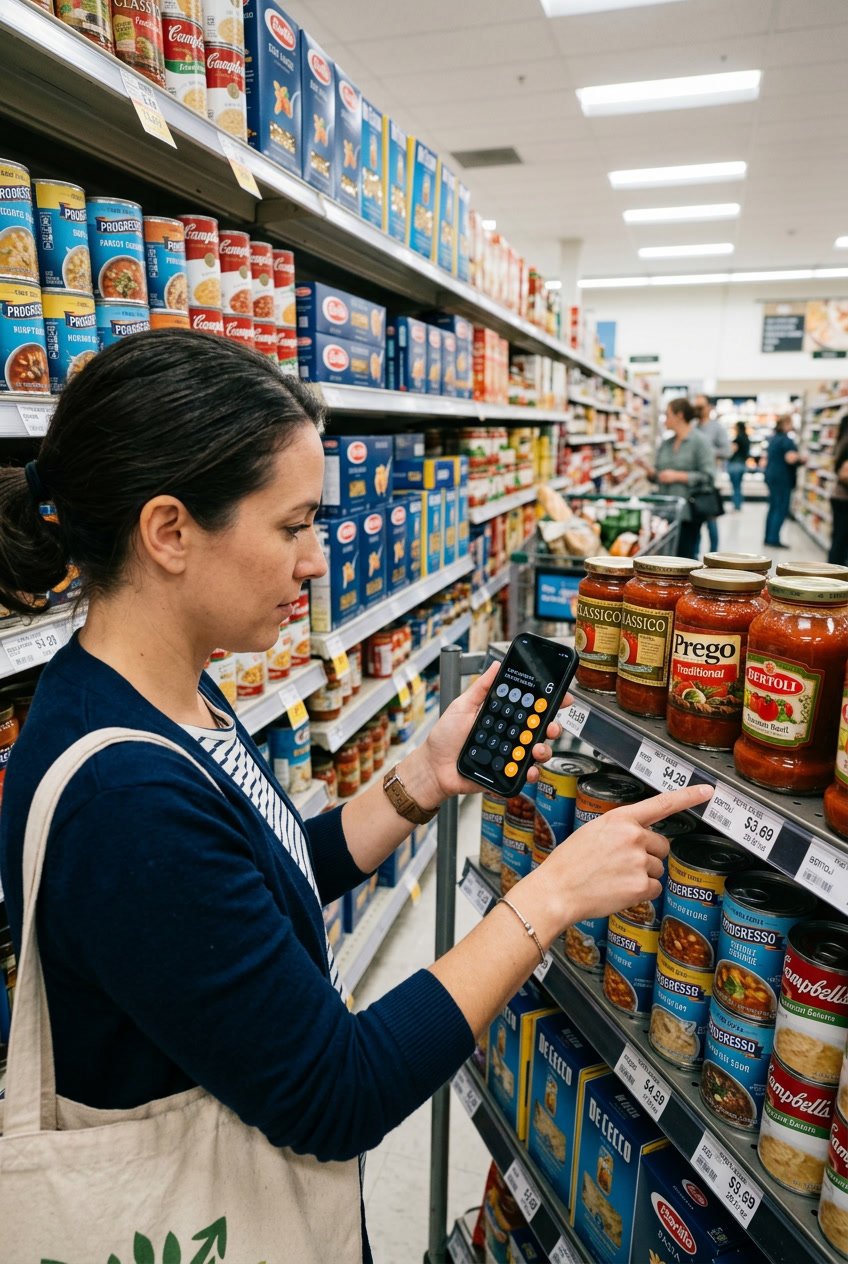
Smart grocery shopping means grabbing the right tools to figure out true costs and spot actual deals. Knowing how to handle discount calculations, taxes, and comparisons helps you keep more cash in your wallet.
Discount Calculators and Price Adjustments

A discount calculator tells you exactly what you’ll pay after sales, coupons, and those “buy more, save more” promos. Stores love “buy 2, get 1 free” or “30% off” deals, but sometimes you’re better off just buying a different brand or size.
Here’s how to do the math:
Buy 2, Get 1 Free:
- Regular price: $4.99 each
- Total: $9.98 for 3
- Per item: $3.33
- Compare to a competitor at $3.50 each—now you know if it’s worth it
Percentage Discounts:
- Original price: $6.99
- 25% off: $1.75 savings
- Final price: $5.24
Some stores make you buy a certain number to get the sale price. A tag might say “$2.50 each when you buy 3,” but charge $3.49 if you only grab one. If you won’t use three jars before they expire, you’re not really saving.
Use your phone’s calculator in the aisle. Multiply the unit price by how much you actually need, then compare that to other sizes or bulk deals.
Factoring in Sales Tax and Fees

Sales tax depends on where you live—could be 0%, could be over 10%. Most basics like milk, bread, eggs, and produce are tax-free in many states. But snacks, candy, and drinks often get taxed.
Don’t forget this in your mental math. If you’re budgeting $100 and half your cart is taxable in a place with 8% sales tax, you’ll pay around $104. That extra $4 adds up to $208 a year if you shop every week.
Taxable vs. Non-Taxable Items:
| Usually Tax-Exempt | Often Taxed |
|---|---|
| Fresh fruits and vegetables | Prepared deli foods |
| Bread and grains | Candy and gum |
| Milk and eggs | Soda and energy drinks |
| Uncooked meat | Hot food from grocery bars |
Some stores tack on bag fees—usually $0.05 to $0.10 per bag. Bring your own and save $0.50 to $1.00 per trip, which adds up over a year.
Check your receipt after a few trips to see your real tax rate. Build that into your budget so you’re not caught off guard at checkout.
Tips for Accurately Comparing Grocery Items

Unit price tags are helpful, but not always accurate or easy to spot. Sometimes stores use different units for similar products—one brand lists per ounce, another per pound.
Here’s how to compare:
- Product A: $0.18 per ounce
- Product B: $2.50 per pound
- Convert Product B: $2.50 ÷ 16 = $0.156 per ounce
- Product B is actually cheaper by $0.024 per ounce
Watch out for packaging tricks. A “family size” box might look bigger but have the same weight as two regular boxes—sometimes at a higher unit price. Check the actual weight or volume, not just the box size.
Compare the same form of a product. Frozen veggies at $0.12 per ounce aren’t a fair match to canned at $0.08 per ounce—there’s water weight and prep differences. Fresh produce usually has more waste from trimming, while frozen is ready to use.
Store brands often cost 20-40% less than name brands for nearly identical products. Generic cereal, canned goods, pasta, and baking supplies usually deliver the same quality for less.
Keep track of prices for your regular buys. Jot down the best unit prices for milk, eggs, bread, chicken, and other staples in your phone. When you spot those deals or better, stock up (within reason). You’ll know at a glance if a “sale” is really just a fancy sign.
Converting Units for Easier Price Comparisons
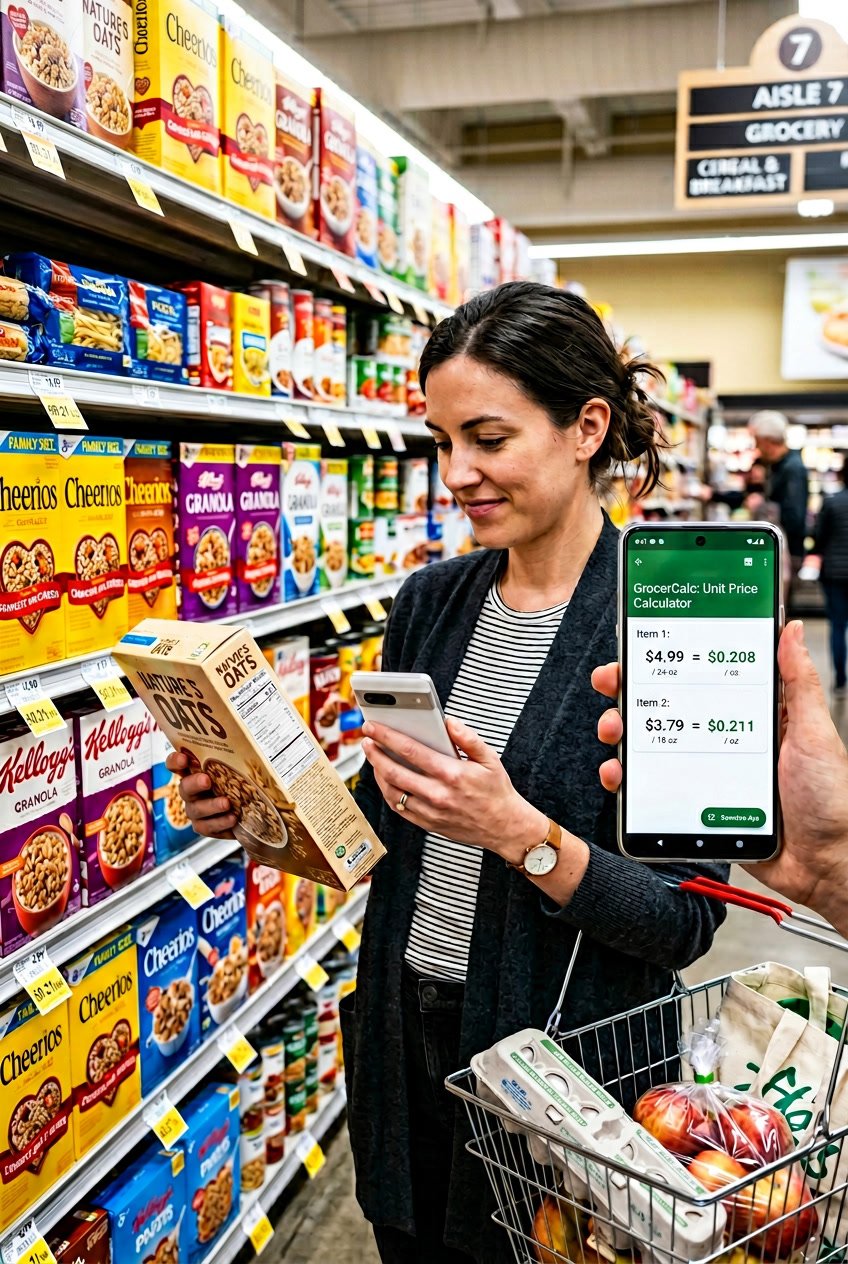
Products come in all sorts of measurements, and you can’t compare a price per ounce to a price per pound without converting first. Most grocery stores put unit prices on shelf tags, but they don’t always use the same units—especially when fresh and packaged items are side by side.
How to Convert Between Ounces, Pounds, Liters, and More

Start with weight conversions. Most groceries use pounds and ounces. One pound is 16 ounces. So, if you’re looking at a 2-pound bag of rice at $3.20 and a 24-ounce package at $2.88, convert pounds to ounces. The 2-pound bag has 32 ounces (2 × 16), making it $0.10 per ounce, while the smaller package is $0.12 per ounce.
For liquids, remember: one liter equals 1,000 milliliters, and one gallon equals 128 fluid ounces. A 2-liter bottle of olive oil at $18 is about 67.6 fluid ounces, while a 16-ounce bottle at $7 costs way more per ounce ($0.44 versus $0.27).
Imported products sometimes mix metric and imperial. One kilogram is 1,000 grams, or about 2.2 pounds. A 500-gram block of cheese at $6.50 works out to about $0.013 per gram or $5.90 per pound.
Does all this sound like a hassle? Maybe, but a quick calculation can save you a surprising amount over time.
Ensuring Consistency When Comparing Items

When you compare items with different units, always switch to the smallest common unit. Let’s say you’re looking at pasta sold by the pound and pasta sold by the ounce—convert everything to ounces so you get an accurate picture. A 1-pound box at $1.99 comes out to $0.124 per ounce, while a 13.25-ounce box at $1.49 drops to $0.112 per ounce.
Manufacturers often play tricks with package deception. They’ll use different units to sneak in price hikes. Maybe you spot flour in a 5-pound bag next to a 64-ounce bag (which is just 4 pounds). That weight difference absolutely matters when you’re figuring out your real cost.
If you’re comparing more than two items, jot down your conversions. Your phone calculator works, but a quick note like “Item A: $0.18/oz, Item B: $0.22/oz” keeps things straight by the time you hit checkout.
Frequently Asked Questions
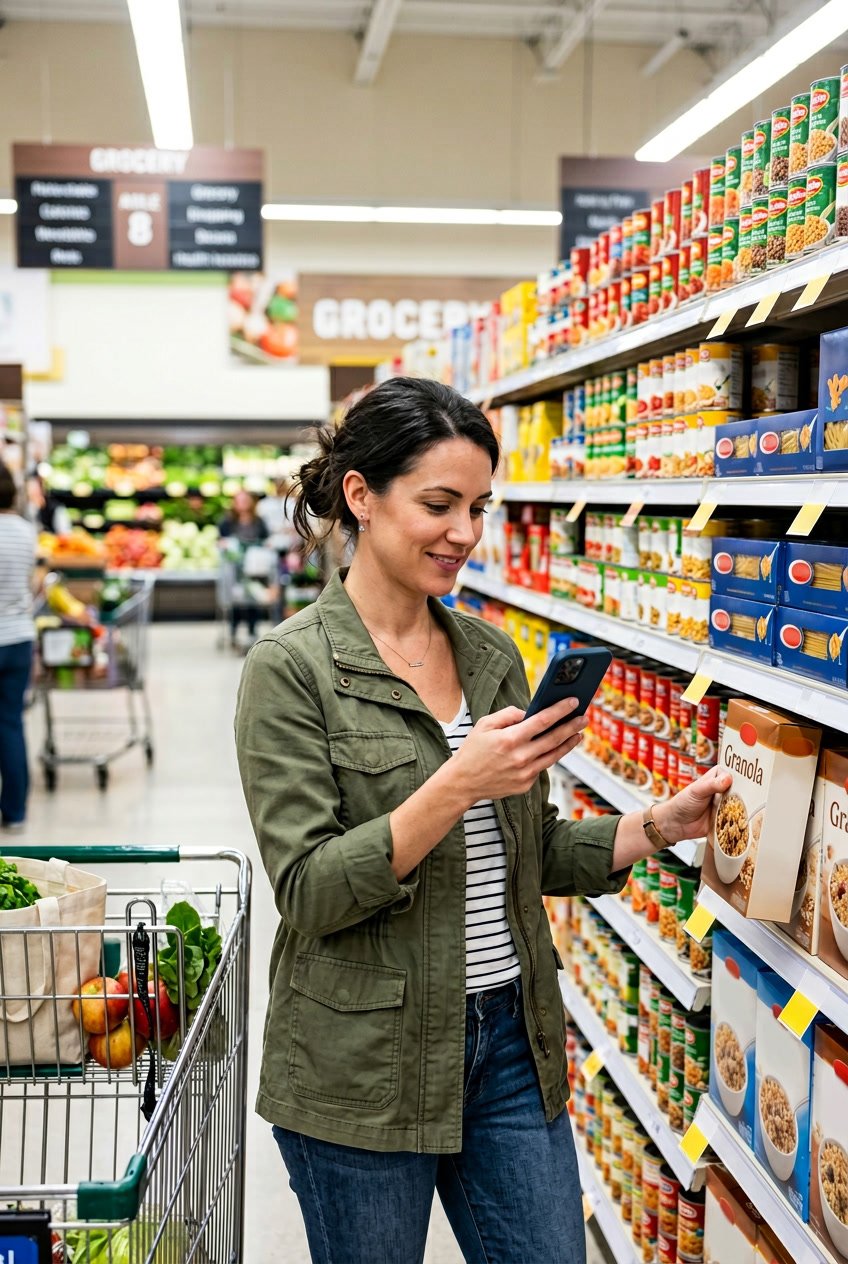
Once you get the hang of the basic formula, unit price calculations start to feel automatic. The real confusion usually comes from different units or not knowing if bulk buys are actually worth it.
How can I calculate the unit price of grocery items to compare deals effectively?
Just divide the total price by the quantity. For example, a 16-ounce jar of peanut butter at $4.80? Divide $4.80 by 16 and you get $0.30 per ounce.
The tough part kicks in when products use different units. Comparing a 2-liter bottle to a 12-pack of 12-ounce cans? You’ll want to convert the 2-liter bottle to ounces (about 67.6 ounces) and the 12-pack to total ounces (144 ounces) before you crunch the numbers.
Shelf tags at stores like Walmart, Target, and Kroger usually show unit prices in tiny print. Check these first to save yourself some math. Still, mistakes happen, so double-check once in a while.
What’s the simplest way to determine the cost per unit when bulk buying at the store?
Pull out your phone’s calculator app right there in the aisle. Type in the total price, hit divide, then punch in the number of units.
If you’re heading to Costco or Sam’s Club, write down the unit prices for your regular grocery store items before you leave. For instance, a 35-ounce container of oats at Costco for $8.99 is $0.26 per ounce, while your usual grocery store charges $0.42 per ounce for an 18-ounce container. That’s a 38% savings per ounce—but only if you’ll actually finish 35 ounces before it goes stale.
Don’t forget about the membership fee. If you pay $60 for a Costco card and only save $40 all year, you’re actually out $20.
Are there any trustworthy apps that help calculate unit prices while shopping for groceries?
Honestly, the free calculator app on your iPhone or Android does the trick for basic math. You don’t need anything fancy for simple division.
Basket and Flipp are grocery apps that show unit prices and compare deals at different stores near you. They pull in real-time prices, though it depends on your zip code. Basket works well in big cities but doesn’t always have data for rural areas.
The downside? You’ll need cell service inside the store, and it adds steps between spotting a product and making a decision. A lot of people just glance at the shelf tag or do quick math in their head for the basics.
Could you guide me on using an Excel spreadsheet for tracking unit prices of my weekly grocery haul?
Set up columns for Item Name, Store, Package Size, Total Price, Unit Price, and Date. In the Unit Price column, use the formula =Total Price/Package Size.
Add a new row every time you buy something, even if it’s the same thing as last week. After four to six weeks, you’ll spot patterns—maybe Aldi beats Walmart on canned goods by $0.08 per ounce, but Walmart wins on paper towels.
Use conditional formatting to highlight the lowest unit price for each item. This gives you a visual shopping guide so you know where to grab what. If you regularly buy 30 items a week, this spreadsheet could save you $15-25 per trip once you settle into a routine.
What are some practical examples of how understanding unit pricing can save money on my food budget?
Take yogurt: a 32-ounce container at $4.99 is $0.16 per ounce. The single-serve 5.3-ounce cups at $0.88 each? That’s $0.17 per ounce. If your household eats 12 cups a week, switching to the bigger container saves you $1.92 a month.
Shredded cheese is another one. An 8-ounce bag of pre-shredded cheddar goes for $3.49 ($0.44 per ounce) but a 16-ounce block is $5.99 ($0.37 per ounce). If you buy blocks and shred at home, you save $0.07 per ounce—about $14.56 per year for families using two pounds monthly.
Spices can be all over the place. A 0.75-ounce jar of basil at the grocery store costs $4.29 ($5.72 per ounce). The same brand in a 3-ounce container at Costco is $8.99 ($3.00 per ounce). But ethnic markets? Sometimes you’ll pay just $1.50 for 2 ounces ($0.75 per ounce) for the same quality.
How do I ensure I’m getting the best value per unit when grocery shopping without spending too much time on math?
Stick to comparing unit prices for the 15-20 things you buy all the time. These basics usually eat up about 60-70% of your grocery budget, so getting them right really matters. No need to stress over every single item in your cart.
Try to remember what counts as a “good” unit price for your favorites. For example, if you know pasta usually goes for around $0.12 per ounce, you can spot a deal without pulling out your calculator every time.
Only bother checking unit prices when you’re torn between two options or when a sale seems almost suspiciously good. For anything under $2, I’d say skip the math—saving a few cents just isn’t worth the hassle.
Leave a Reply